


Deformed joints most commonly affect the lower limb joints, one of which is the ankle joint.These joints have great mobility in different planes, perform important functions while walking (rolling the foot and transferring body weight from heel to toes), and also bear the body's weight.Arthritis of the ankle joint is a consequence of upright posture.But many other factors also play a role in the development of the disease.First, without the patient noticing, the cartilage covering the joint begins to soften, thin, and then break down, triggering an inflammatory process and the growth of bone tissue in the form of osteophytes.With advanced arthrosis, the person is unable to move without support and experiences severe pain, especially when leaning on the legs.If comprehensive treatment is not started early, disability may develop within a few years of onset.
Cause of disease
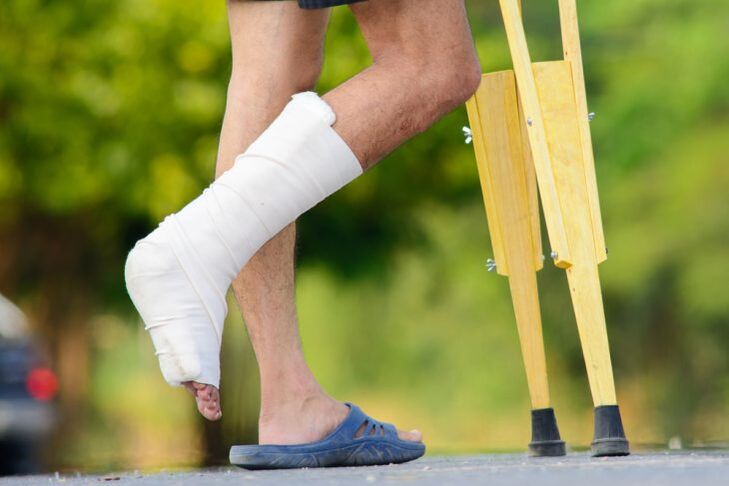
Previous injury to the ankle joint increases the likelihood of degenerative changes in the ankle joint.
- weight gain;
- Flat feet, congenital foot deformities (caudal foot, clubfoot);
- Metabolic disorders caused by diseases such as diabetes, gout, and atherosclerosis of blood vessels in the legs;
- Previous joint injuries, such as ligament injuries, ankle and foot bone fractures;
- Continuous overloading of joints, resulting in microtrauma (athletes and weight-bearers);
- genetic predisposition to joint arthritis;
- Previous infectious joint inflammation (arthritis) or systemic disease (rheumatoid, psoriasis, gouty arthritis).
Ankle joints can be primary or secondary, depending on the presence or absence of specific factors that cause the disease.There are also stages.If stage 1 is present, a person is able to work; if the arthrosis progresses to stages 2 and 3, pain and limited mobility can lead to disability (temporary or complete).
Symptoms of ankle arthritis
- "Starts" pain.This is one of the early symptoms of ankle arthritis.Pain occurs when trying to lean on the legs after sitting for long periods of time and may be accompanied by short-term stiffness of the joints.After a few steps, the pain disappeared;
- pain during and after physical activity;
- Pain at night is related to the inflammatory process caused by the destruction of cartilage tissue;
- Creaking, clicking sounds in joints when moved;
- Swelling, especially below the ankle;
- restricted movement;
- As a person begins to avoid leg soreness, resulting in muscle atrophy and ligament weakness around the joints;
- End-stage joint deformation.
diagnosis
It is necessary to distinguish arthropathy and its exacerbations from various inflammatory processes in the joints, for example, those caused by rheumatoid gout or psoriatic arthritis.Therefore, the doctor will perform detailed blood tests, rheumatoid tests, CRP and uric acid tests.For arthropathy, these indicators are normal, but if the disease is in the acute phase, the erythrocyte sedimentation rate and white blood cells may be elevated.To determine the stage of arthropathy and to obtain more detailed information about the pathology, radiography using 2 projections of the joint, ultrasound, CT, or MRI is required.If the joint is in Stage 1, an X-ray may show a slight narrowing of the joint space.Transitioning to stage 2, the joint space is 40% or more smaller than normal.In the third stage, it narrows significantly and may not actually exist, and bone growth and deformation are visible.
Treatment
Arthropathy of the ankle joint, as elsewhere, requires complex, long-term, and therapeutic treatment.
- During severe attacks (walking with a cane on the good side), use a bandage to reduce the load on the ankle joint;
- Eliminates impact loading (jumping, running), vibration, lifting heavy objects, standing for long periods of time;
- weight control;
- quit smoking;
- Wearing semi-rigid orthotics with associated joint instability;
- Physical therapy (UHF, SMT, laser therapy, magnetic therapy);
- Medication:
- NSAIDs topical, oral, injected;
- Glucocorticoids work with intra- and peri-articular anesthetics to reduce inflammation;
- Vascular agents;
- Muscle relaxants to eliminate spasms in muscle tissue;
- Chondroprotectants – Medications given intra-articularly are more effective.If intra-articular injection is not possible, intramuscular or oral injection is required;
- Hyaluronic acid preparations restore synovial fluid quality.
- Orthopedic insoles, comfortable shoes with small heels;
- Gymnastics can strengthen muscles and ligaments.Recommended exercises should be performed daily:
- Lying or sitting, bend and straighten your toes 10 times;
- Lying or sitting, pull your feet closer or further away from yourself 10 times each;
- Turn your feet outward 10 times;
- Make circles with both feet clockwise and counterclockwise 10 times each;
- Sit on a chair with your feet on the floor, your toes and heels together, and move your legs back and forth alternately. Repeat 15-20 times.
- swimming, water aerobics;
- In the third stage of arthrosis and when conservative treatment fails, it is necessary to use an ankle endoprosthesis or to remove the damaged cartilage covering and joint capsule and close it with a rod structure or an Ilizarov device (arthrodesis).
prevention

To reduce the risk of joint disease, high-protein foods should be given priority in the diet and spicy, salty, fried foods and alcohol should be excluded from the diet.
- Avoid joint injuries.For this reason, it is necessary to try not to wear shoes with unstable heels or too hard soles, and to use special protective equipment when exercising;
- control weight;
- You need to stick to your diet, eat more protein-rich foods, and avoid salty, spicy, fried, and alcoholic foods;
- Timely treatment and correction of metabolic disorders, endocrine and vascular diseases;
- Perform the above exercises on the ankle joint.
The effectiveness of treatment for deforming arthritis of the ankle depends on its stage of development and the presence of concomitant diseases.Regardless, if conservative treatment is required, it should include medical and physical methods, as well as correction with orthopedic products.
Which doctor should I contact?
If you have ankle pain, you should consult a rheumatologist.Doctors will prescribe exercise, medication, and find the cause.If you have diabetes or gout, it can be helpful to see an endocrinologist; if you have atherosclerosis in the blood vessels of your lower extremities, it can be helpful to see a vascular surgeon and cardiologist.The orthopedic surgeon plays an important role in treatment - not only will he help you choose the right shoes and orthotic insoles, but he will also perform surgery if necessary.If you are overweight, you need to be examined by a nutritionist to choose appropriate nutritional products.Non-pharmacological treatment is carried out with the participation of a physical therapist.